The boat trip from the mainland to the island is fast. Just a few minutes. You can easily see across the water. And yet it feels like another world coming to the island.
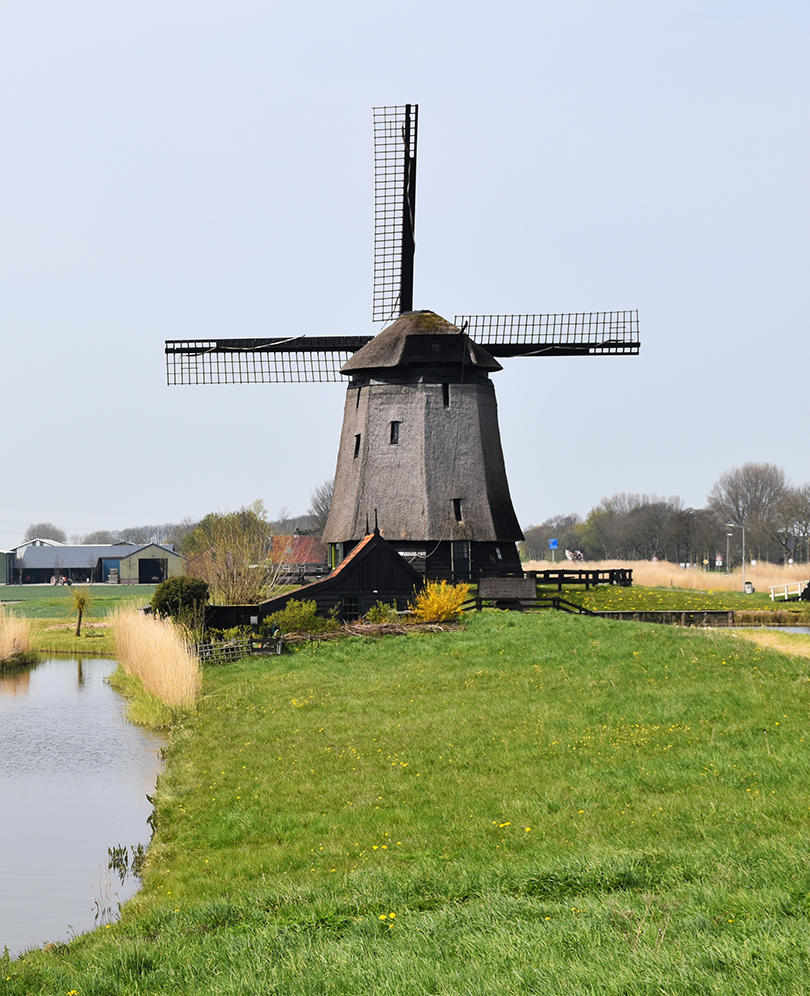
A sign on the house welcomes us: De Eenzaamheid means Loneliness. We have arrived at the house and farm dairy of Jan and Roos van Schie. The island is in a lake in the Zwanburger Polder, south west of Amsterdam. It covers 1 square km / 247 acres and their neighbors are a farmer and a windmill. We are 60 cm / nearly 2 ft below sea level. The old sea bed contains sea clay which makes the milk special.
Organic and raw milk
Jan and Roos took over the farm in 1984 and are the fifth generation of farmers. Today, they have 42 cows and make 7 cheeses a day in the small dairy. The cheeses are organic raw milk cheeses under the brand Wilde Weide (which means Wild Meadow). They share the brand with another local farmstead dairy.
You can buy Wilde Weide in Holland but also in the US and at Borough Market in London.
‘Boerenkass’ versus ‘kaas van Boeren’
Wilde Weide is a ‘boerenkaas’ which translates to ‘farmhouse cheese’. This refers to a raw milk cheese produced on the farm and which is heated to no more than 35°C / 95°F. When you talk about ‘kaas van Boeren’ or ‘kaas van de boerderij’ (cheese from the farm), you talk about a cheese made with pasteurized or thermized milk.
Let’s take a look at the dairy!
Making cheese is know how. How the curd feels and looks… it takes experience.Jan captures the curd with the metal band and presses it slightly togetherAfter a few moments, the curds have become cheeses and can be flipped.Each cheese (around 13,5 kg) are being transfered to the press.Jan adjusts the press and more whey leaves the cheeses.Kaas is cheese, and in the cellar the cheeses go into a brine first. Thereafter they mature for around two weeks before they are being aged further by a third party, for instace Fromagerie L’Amuse.A break with coffee, farm milk and the Dutch stroopwafel…Enjoyed cheese for lunch – as well as the view towards the mainland which seems far away from the island life.
This was my last story (for the moment) from an unforgettable cheese journey to the Netherlands.
More cheese journey?
You can read the other parts of my story here: Beemster (a cheese area and cheese brand) A morning at Alkmaar cheese market Remeker – a farmstead dairy with a different mindset than most others Additional top 10 moments from the trip
And you can read more about Cheese Journeys who planned this trip.
Would you like to receive more cheese stories in your mailbox? Sign up for inspirational mails right here (and get a link to download a guide to the best cheese board)
Every Friday morning from April to the end of September, a show takes place on the square in the small town Alkmaar. We are in North Holland, home for Nord Hollandse Gouda PDO. But this is not just a show for tourists (even though lots of tourists come). This is still a cheese market where 30 tons of gouda this morning is evaluated, sold, carried to be weighted and off to the buyer. What makes this market very special is its roots that go back to 1593. (Even though cheese trading took place before).
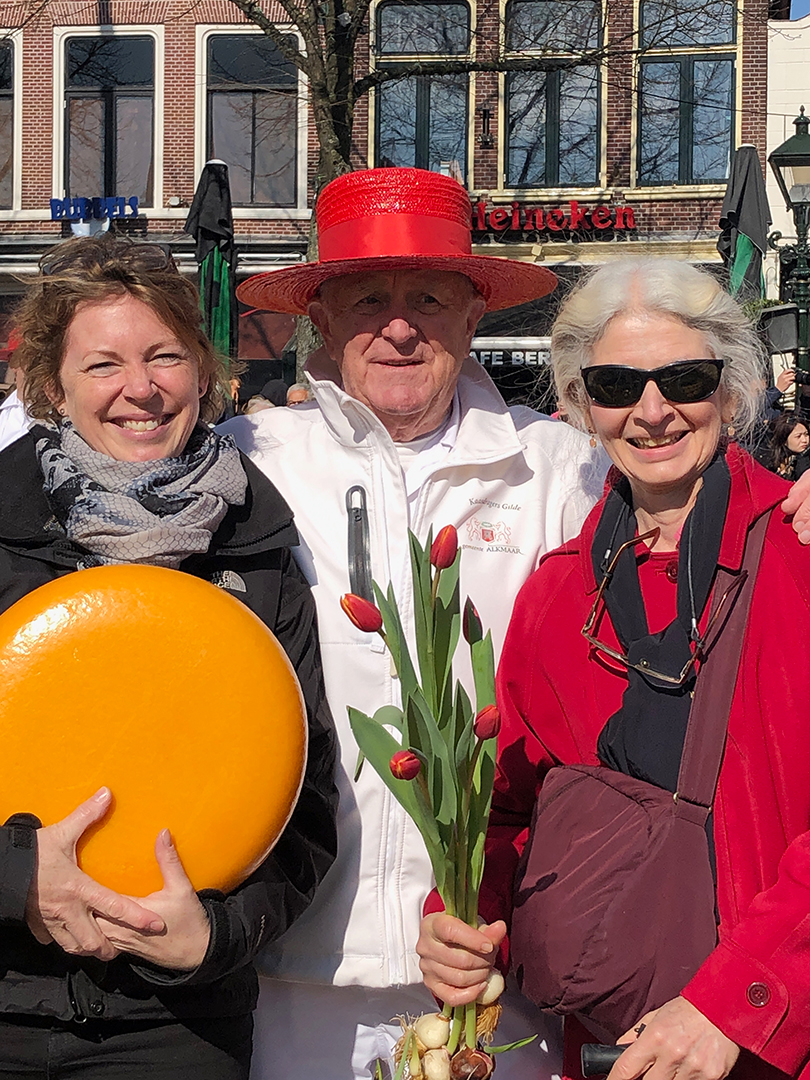
30 tons of gouda waiting on the square. All PDO gouda from Cono or Campina-Friesland.This particular Friday was ‘Tulip Day’, thus the many tulips.
The guild
The market is run by the old ‘Kaasdragers Gilde’ which means cheese carrier’s guild.
The guild from 1593 keeps alive the old rules. For instance, you are not allowed to swear on the market place. If you do, you pay a small fine. If you’re late, you pay. If you’re clothes is stained, you pay. The money from this and the cheese sales was collected and shared between the cheese carriors during winter.
In the old days, the guild took care of the cheese carriors and their families in case of illness and death.
The cheese father is above all. Until 1920s he lived in the guild’s house by the square. But still he today, the other cheese carriers call him ‘dad’.
Once a cheese carrier, always a cheese carrier. And that is still true.
Balance
To carry eight goudas (108 kg / 238 lb.) plus the wooden barrow requires balance. To start off well, the one in front always starts with the left leg, whereas the one behind starts with the right leg.
The cheeses at the market were round until 1922. Flat goudas of today are much easier to carry.The carriors take the sold cheeses to the weight. Then the final settlement is made with the buyer.
Four teams are working on the market. Each team consists of six carriors and one purseman who used to receive the money for the sold cheeses. An official oversees still today that everything is correct.
It was obvious to see that the cheese carriers had fun. Also I found it interesting to see how the past still lives in the presence. And how important cheese has been and still is for this area.
Money was collected in this box from 1730
Visit the market
You can visit the market every Friday morning from April to the end of September. Read here about how and where. Beside the market is a cheese museum and a gift shop with a broad range of cheese souvenirs.
Going to the Netherlands means going to the land of gouda. But you don’t have to stay long to understand that there are differences between gouda and gouda.
If you stay in the inner center of Amsterdam you meet several well merchandised cheese shops with gouda in all colors (added spices) and without. But if you go outside Amsterdam and visit the smaller dairies you’ll see that even though they produce gouda, they refer to their cheese by the brand and not as gouda.
Protected name or not?
Gouda is one of the cheese types (like cheddar) which isn’t protected by its origin (PDO). This means gouda is produced all over the world today. But yet there are two protections: Nord-Hollandse Gouda (gouda from North Holland) has the PDO stamp, and Gouda Holland carries the PGI stamp.
Gouda is a town in South Holland. This is the place to stroll along the channels, enjoy a stroopwafel and visit the cheese market on Thursdays during spring/summer.
Beemster, the area
In the beginning of the 17th century, Amsterdam needed more farm land. Beemster lake was the biggest lake in North Holland with a connection to the sea. In the beginning of the 17th century, a wild project started: 43 windmills pumped out the water over the next few years. Dry land was found 4 meters / 13+ feet below sea level. Windmills are still used today to pump out water and keep the land dry. Today, it is protected as Unesco Heritage, as the first polder in the Netherlands.
The plan was to use the reclaimed land for agriculture. But the soil was too wet. Yet it was perfect for grass and cows. The soil is old sea bed, fertile mineral marine clay, rich and salty.
The grass that grows here has a high level of Omega 3 which adds to the milk quality. However, if the grass gets too long, the Omega 3 dissappears. Therefore, it needs to be cut at the right length when turned into hay 🙂
The plan for the reclaimed land from the old lake. And so it is today: Straight roads, dykes and water channels.With so much water all over, maybe it’s no wonder the Dutch king has an education in Water ManagementLocks are used to manage the different levels of water
Beemster, the cheese
4% of all Dutch cheese comes from Cono Kaasmakers, a cooperative in Westbeemster (the biggest player is Friesland-Campina with 75%).
Cono started in 1901 and covers today 460 farmers who in average have 70 free range cows per farm. Their biggest brand is Beemster.
Even though it is an industrial production, they still use some traditional techniques. For example, the cheesemaker stirs the curd by hand (he uses a rake) which ensures an even drainage and thereby a smoother texture.
Cono claims to be the greenest dairy in the world and is aiming at being CO2 neutral in 2020. In 2008, they launched their Caring Dairy-project (‘happy cows, happy farmers, happy planet’) which focuses on sustainable dairy farming. Cows are out 180 days a year, live longer, have better health and give more milk.
Noord-Hollandse Gouda PDO
The old marine clay in the soil is the secret behind the unique taste of the cheeses coming from this area. The blue marine clay gives more taste to the juicy grass and thus to the milk. At the dairy they add less salt which leaves room for a more natural and complex taste.
Gouda from North Holland carries the PDO stamp. One of the describing factors for this particular gouda is a lower salt content than in other goudas. Two producers make this particular gouda (Cono and Friesland-Campina).
Beemster cheese come with different maturations from 1 month to 26 months. From buttery and creamy to crymbly, drier and more caramelHappy in the land of gouda… 🙂