Tag: raw milk cheese

  • Beaufort from the top of the world

    Beaufort from the top of the world

    I worked as ‘cheese educator’ on an Alpine Cheese Journey – and this beaufort experience was without doubt one of the highlights.

    But before we get to the cheese, the two moments below helped set the scene:

    Scene 1:
    IN THE LIGHT OF THE MOONLIGHT

    The moon shines down from the dark morning sky onto the courtyard in front of our château. I realize that here is a group of people who have defied their body’s need for sleep and set an alarm clock. Why? Because we’re about to experience beaufort coming into the world in an alpine hut in the heights.

    Scene 2:
    THE JOB OF THE ‘CO(W)-PILOT’

    Every time the minivan enters a curve, Anna from Cheese Journeys honks the horn to warn downhill drivers. Meanwhile I keep a close eye on the pictures sent by our scout Teresa Kaufmann in WhatsApp, trying to find them outside the minivan: a wooden sign, a small group of houses, etc.

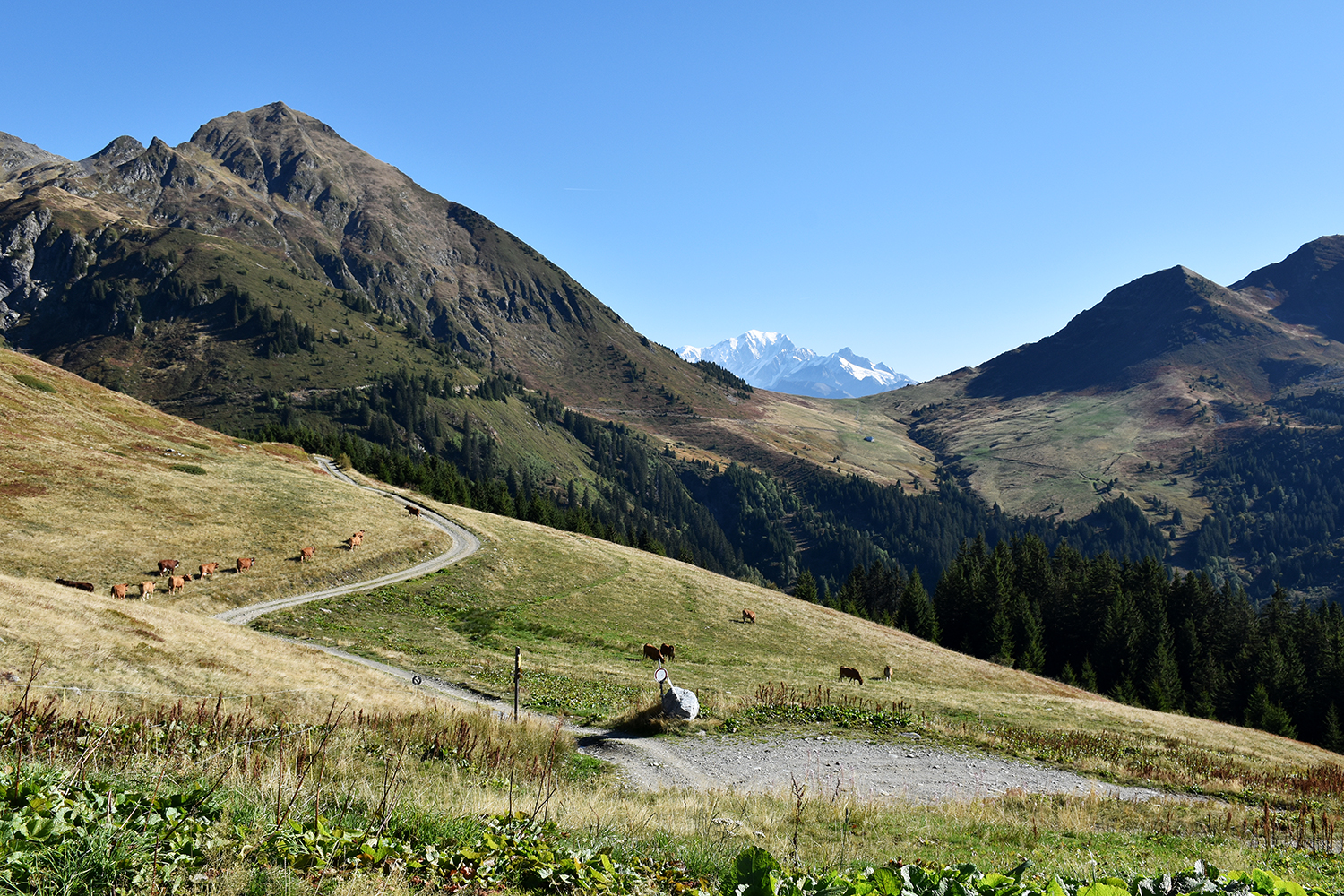
    Asphalt turns into a dirt road and the darkness is suddenly replaced by the sun. We pass the tree line – and finally we arrive at Chalet Bellachat.

    Three times Beaufort AOP

    Since 1968, beaufort has carried the AOP label, which guarantees its protection of origin. All beaufort cheeses are classified into three qualities depending on the milk and place of production:

    • If the cheese is simply called ‘beaufort’, it is made between November and May, when the cows are in the barn down in the valley. At this time of year, they mainly eat hay, which makes this type of beaufort the mildest of the three.
    • Beaufort Été means ‘summer beaufort’ and is made with milk from cows grazing outside (typically between June 1 and October 31). This type of beaufort is more yellow and fruity in flavor due to the 130 or so plant species per square meter that the cows munch through in the mountain pastures.
    • Beaufort Chalet d’Alpage – or ‘alpine chalet beaufort’ – represents the smallest part of the beaufort cheese wheels. The milk for this comes from cows grazing in the high altitudes, above 1,500 meters (around 5,000 ft). In addition, cheeses must be made twice a day with milk from the farm’s own herd using traditional methods.

    It was this last type of cheese, the Alpage variety, which was made at Alpage Bellachat.

    Alpage Bellachat

    Nathalie and Jean François greet us on this September day, just before the end of the season. Their day also starts early, as the first milking is at 4:15 am (the last at 5:15 pm). The cows recognize voices and come to the mobile milking machine themselves to be milked.

    Jean François and his brother took over this alpage (alpine hut) 18 years ago. Their parents had a small farm further down at an altitude of 1300 meters (4,260 ft), below the border of the ‘alpage’ area.

    Today, the couple has 90 cows of the breeds Tarine and Abondance, the two breeds of cows that may be used for beaufort cheese.

    Two tough mountain ladies

    The two permitted breeds are perfect for alpine areas.

    One is the tarine (or tarentaise, as it’s also known). It is a hardy caramel-colored cow. The other is the Abondance, known for its mahogany red coat with white markings. Often they have ‘lunettes’ or spectacles, as the color around the eyes is called.

    Both cows are also not allowed to produce more than 5,000 liters (1,320 gallons) of milk per year per cow. This is less than most other milking cows.

    The drought that Southern Europe has experienced in recent years is also felt at Alpage Bellachat. The lack of precipitation leads to a shortage of grass. Last year they got a dispensation to start feeding hay earlier than usual.

    The cows graze in shifts between two areas around the dairy farm. This ensures that the grass comes back. Jean François tells us that you have to maintain the ‘alpage’ by grazing, otherwise the pastures will be taken over by blueberries and other plants.

    Inside the dairy

    In the small dairy, a large open copper vat greets us. It holds 400 liters (105 gallons) of milk, which makes a 40 kg (88 lb) cheese.

    The curdled milk is cut into cheese grains and then stirred to separate more whey. The cheese grains must be quite small in order to become a hard cheese. The vat is heated with gas and the copper conducts the heat around in a balanced way that slowly brings the milk up to 55°C/131°F while stirring. This also helps to get the whey out of the cheese grains.

    The cheese maker showed us how to know when the cheese is sufficiently acidified: You can form a small ball of the curd and easily dissolve it back into cheese grains.

    When it’s time to get the curd out of the vat, the cheese maker leans over the vat with a net in his hands. Hanging there, he stems his feet against the back wall and in one swift motion, he catches all the cheese curd in his net.

    Using a hook, a string and a rail in the ceiling, the curd filled net is transported to a wooden mold, where it is pressed for 24 hours.

    The whey is used to make fresh cheese (fromage frais).

    Magic in the cheese cellar

    A bit down the sloping gravel road is the cheese cellar. Here, the new cheeses are first left with salt on the surface for 24 hours to form a rind. They they spend another 24 hours in a concentrated brine. The cheeses then ripen for about 10 days and are regularly rubbed on the surface. You always start with the oldest cheeses, as this way the good bacteria are spread to the youngest cheeses.

    The beauforts are then transported down the valley to an affineur, who further ripens the cheeses under more controlled conditions. To be a genuine beaufort cheese, it must be aged for a minimum of five months in the Beaufort area.

    The connection between skiing and cheese

    Many cheesemakers in the area double job as ski instructors in the winter while the cows are stabled down in the valley. So does Jean François, who is a cross-country ski instructor in the winter time.

    Lunch with a view of Mont Blanc

    After the visit to the dairy and cheese cellar, we quickly set up a long table with tablecloths and served our lunch. Jean François brought some beaufort cheeses with different ages to the table.

    Beaufort. A view of snow covered Mont Blanc. The soft sound of cowbells in the distance.

    It doesn’t get any better than this!

  • The story behind comté

    The story behind comté

    Did you know that comté cheese is the French’s favourite PDO cheese (PDO = protected designation of origin)? And that it was the first French cheese to be protected by origin in 1958?

    This classic cheese was of course also on our agenda when I visited the French Alps and the Jura Mountains with Cheese Journeys. We visited both a dairy and an affineur who ripens the cheese. In this blog post I will take you with me back to the Jura.

    A historical structure

    Around 1.7 million wheels of comté cheese are produced every year, each weighing around 40 kg / 88 lbs. Each cheese requires 450 litres / 119 US gallons of milk. Since one cow gives about 20 litres / 5.3 gallons of milk a day, 23 cows are needed to make one cheese. In addition, the PDO requires each cow to have one hectare of pasture. This requires large areas of land, which was also the case 1,000 years ago up in the mountains. But with relatively few cows per farmer, it was more practical to join forces when it came to cheese making, hence the birth of cheese cooperatives (‘les frutières’). Today, cooperatives are still responsible for making the cheese, while the maturing process is taken care of by the specialists, ‘les affineurs’.

    Let’s start at the beginning, with the cows.

    The cows

    150,000 cows give milk for comté. 95% are Montbeliarde cows, the remaining 5% are French Simmental. The cows eat only grass and hay. In winter (December to April) the menu is locally produced hay, while the cows graze through fresh grass outdoors the rest of the year.

    Comté is a raw milk cheese, which also means that the subtle notes in the milk from grass and hay are more apparent. Cheeses made from winter milk have a lighter yellow color than summer cheeses, where the natural coloring of the grass gives a darker yellow hue.

    Drought affects the seasons

    As elsewhere in southern Europe, 2022 has been marked by drought. This meant, among other things, that hay feeding began earlier in the fall than usual. And that cows began to eat fresh grass earlier, which meant that summer milk was already available halfway through April.

    At the dairy

    Today, there are about 140 cheese cooperatives left. In French it’s called a ‘fruitière’. The term comes from the French word ‘fructerie’ and refers to the fertility of pooling milk to produce large quantities of cheese. As well as being a practical and necessary gathering place for milk in the old days, ‘le fruitière’ was also a social gathering place for farmers.

    This is why it is still an AOP requirement today that milk comes from several farms. The milk cannot be transported more than 25 km / 15 miles to preserve its quality, and the cheese must be made within 24 hours of milking.

    Each dairy produces between 7 and 120 cheeses a day. After 10 days, cheeses are taken to an affineur, who ripens the cheese further. The dairy can easily work with several different affineurs, and in this way the same dairy’s cheeses can end up having many different personalities.

    L’affineur

    Today there are 16 affineurs or maturing cellars, where the potential behind each comté wheel is revealed. A comté must mature for a minimum of four months, the average is 18, and some can mature for as long as 36 months.

    The role of the affineur is to bridge the gap between the producer and the customer. With knowledge of the cows, the area and the dairy, each wheel of cheese is brought to perfection for the customer who buys it. After all, there is a difference between the cheese being sold at a local French cheese shop and the cheese ending up on the counter in California.

    In the Jura mountains, the affineurs like to use maturing cellars which naturally create good conditions for the cheeses, such as an old railway tunnel or an abandoned military fort.

    I visited Marcel Petite at Fort Saint Antoine.

    Inside the military fort

    In the heart of the Jura Mountains (1,100 m / 3.600 feet above sea level) and close to the dairies, we find Fort Saint Antoine, built in 1879-1882. It was only in use for five years before the 420 soldiers left.

    Marcel Petite started as a cheese maker in 1932, and in 1966 he came across the military fort. He saw that the thick stone walls and an insulating layer of earth on top would provide the perfect conditions for a slower ripening of the cheeses than was used at the time.

    Under the fort is a water reservoir filled with rainwater and melted snow, providing the soldiers with their own water supply. This keeps the humidity in the fort high. A tunnel to the nearby forest provides natural ventilation. All of this gives optimal conditions for the unique and natural bacteria that are right here and that characterize the cheeses which mature in the fort today.

    At the centre of the fort is an octagonal ‘cathedral’. Here lie as many as 100,000 wheels of cheese in the age between 2 and 36 months. An impressive sight!

    Slowed down

    Back in the days, comté cheeses were aged at 16-18°C / 60-64°F, which allowed them to ripen quickly and reach the market faster. However, this method of ageing also meant that the delicate nuances and subtle hints of sweetness of the milk were not expressed at all. And maybe most remarkably, the cheese had holes (almost like an Emmental). Just look at the old advertisement below.

    The microclimate of Fort Saint Antoine ripened the cheeses more slowly with the lower temperature (8-9°C / 46-48°F) and higher humidity (95%). This gave the cheese a completely different flavor profile. This slow maturing changed comté cheese forever, as the other affineurs soon began to do the same.

    Knocks on every cheese

    In the maturing process, an important step for the cheese master is to ‘ring the wheel’ or hit it several times with a small hammer to make an overall scan of the cheese inside and to detect a possible large crack or hole.

    Age matters the least

    Then a sample is taken out with a so-called ‘cheese iron’. The interior of the cheese is assessed for appearance, taste, texture and smell. Age is also important but not decisive and always comes after the organoleptic assessment. Only when the cheese has developed the desired personality, it will be sent to the market.

    In a Marcel Petite Comté catalogue, the age of the cheeses were not mentioned at all. Instead, they were described only on the basis of their other characteristics.

    Ageing develops the flavor

    As with other aged cheeses, each wheel of cheese tells us a story about the past: About the pastures where the cows grazed, about the season, about the cheese-maker’s skills and about the cheese cellar where the cheese has been aged.

    In fact, 83 flavor markers have been identified for comté and they can be divided into six groups: Lactic, fruity, toasted, vegetable, animal and spicy. Some cheeses may have all the flavours, but most have a few which dominate.

    The flavor wheel helps to find the right words to describe the flavor. Use it the next time you have a comté in front of you.

    At the dairy, they sold their own cheeses matured by three different affineurs. You can then choose the comté you like best for the situation!

  • Bright and shiny stars on the British cheese sky

    Bright and shiny stars on the British cheese sky

    One of the highlights of my trip to England with Cheese Journeys was an evening we shared with no less than England’s rockstar cheesemakers when it comes to artisan cheeses. Among them, so much cheese knowledge, experience and storytelling was accumulated. They each shared their own unique story, which together tell the story of English cheese traditions and renaissance.

    Here you will find some examples of the cheesemakers’ own stories. (All photos of the cheesemakers are taken by talented Winter Caplanson, while the cheese photos are my own).

    Ticklemore – a delicate goat cheese

    Greg Parsons owns Sharpham Dairy, which makes cheeses from cow, sheep and goat milk. The dairy is located in Devon.

    On the cheese night, Greg brought Ticklemore, a fine semi-solid goat cheese made from pasteurized milk from three local farms and with a thin and soft layer of white mold. With flavor notes of citrus and hay, it is a fine and mild goat cheese.

    Baron Bigod – UK’s answer to Brie de Meaux

    Jonny Crickmore is third generation on Fen Farm, a family farm he runs with his wife, Dulcie.

    Raw milk is close to their hearts, and when they went into cheese production in 2012, it was to make their own version of the French Brie de Meaux. In close collaboration with Neils Yard Dairy and a French cheese consultant, they replaced their Holstein-Frisian dairy cows with French Montbelliard cows, which Jonny hand-picked out of small herds in the Jura Mountains. Much is done by hand, for example are cheese curds hand ladled into forms.

    Baron Bigod is a wild and creamy experience with a taste of butter, mushrooms and hay, and with a touch of barn in the beautiful way.

    Tunworth – this is how camembert tastes in England

    Stacey Hedges is originally from Australia. At the age of 40, she found herself in a midlife crisis. With three children in the house and goats in the garden, she found happiness in making cheese.

    She kept making cheese, and with Neils Yard Dairy having her back, she replaced the kitchen table with a small dairy. This was the beginning of the Hampshire Cheese Company. Today, she and her partner buy cow’s milk from a local farmer, with whom they work closely. The cows are a mixture of montbeliarde, red Swedish dairy cow and holstein-friesian.

    Tunworth is an English handmade version of the French camembert. The milk is pasteurized, but not skimmed as it’s the case with a French camembert. The taste is rich and creamy, buttery with notes of hay and meat / umami.

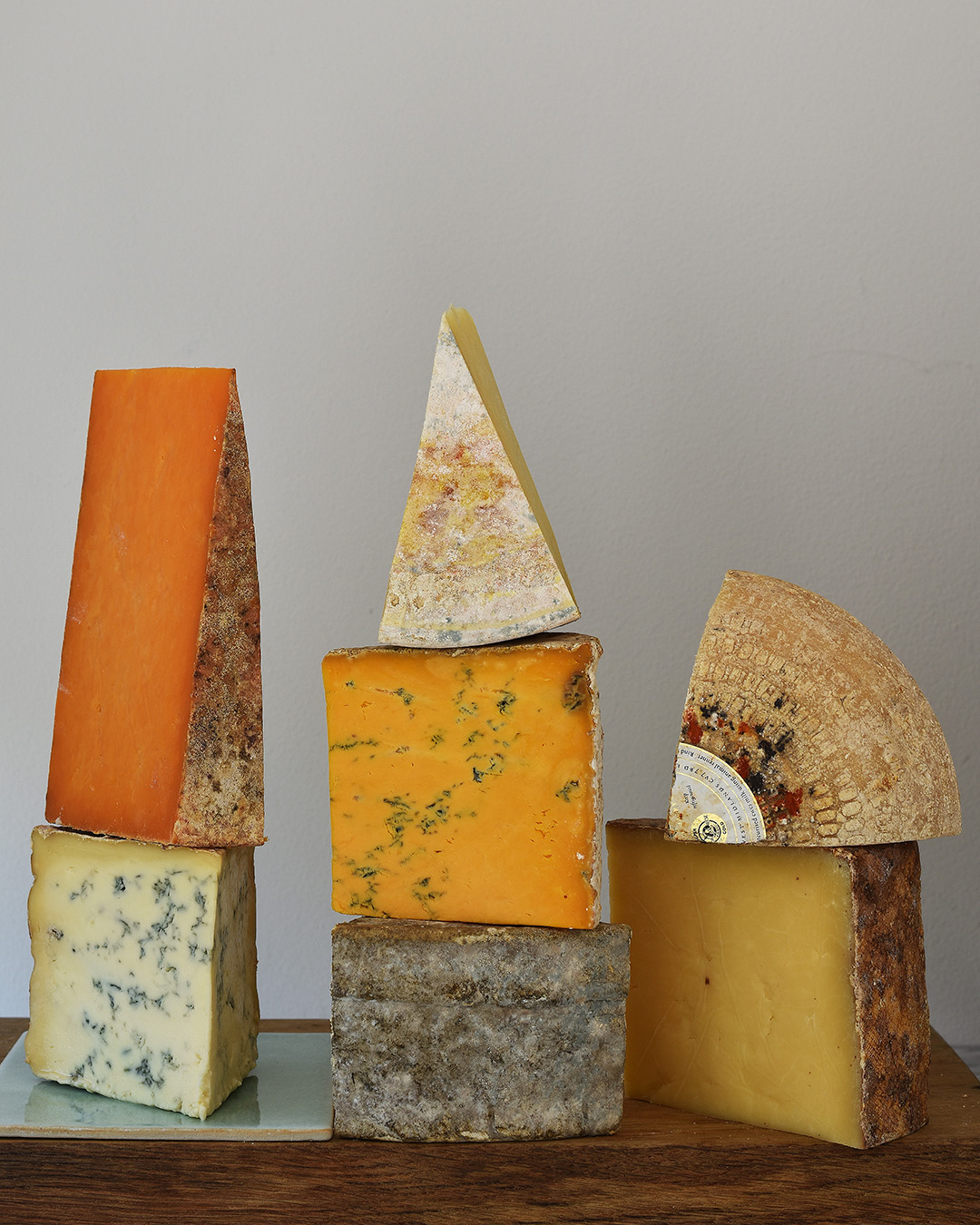
    Each cloth bound Cheshire encapsulates a moment in time – the soil, the traditional grass pastures, the gentle cows, the weather, the season.

    Appleby’s Dairy

    Caerphilly – as Chris Duckett made it

    Originally, caerphilly is a Welsh cheese which the miners took with them in the lunch pack down in the dark. Somerset producers adopted the cheese in the late 1800s, when demand exceeded supply and it became a faster way to generate liquidity than long-aged cheddar cheeses.

    In 1950, there was only one farmhouse producer left: Chris Duckett. He made raw milk caerphilly with natural rind. When he became ill in the late 1990s, Westcombe Dairy took over his production including the 20-year-old brine with all its unique microbiological flora. Even the cheese notes of Chris Duckett’s mother came to Westcombe where they since have worked on taking the cheese even further back to what it originally was.

    Westcombe Dairy has been making cheese since 1879. It is an innovative dairy run by father and son. Primarily they produce traditional farmhouse cheddar.

    Duckett’s Caerphilly has a fresh, clean and acidic taste with citrus, umami and mushrooms. Notice the color difference between the cheese just beneath the rind and in the middle – it also varies in taste.

    Applesby’s Cheshire – last farmhouse producer of cheshire

    Since 1952, the Appleby family has been producing cheshire on their family farm, which today is run by third generation: Paul and his wife Sarah and their five children. Paul’s grandmother came from a family where women made cheese, and she brought that skill into her marriage. The couple established a small dairy in the stable. In this same place and with grandma’s equipment (and with the same passion and stubborness as she had), England’s last farmhouse cheshire is still very much alive. (Once cheshire was a cheese used to feed the whole nation.)

    Appleby’s chesire is clothbound and made from unpasteurized milk from their own cows. The nice, bright orange cheese is a bit acidic and has a slightly crumbly texture. It has a lot of minerality and a notes of grass and sweet cow breath.

    Sparkenhoe Red Leicester – the resurrection of an extinct cheese

    Jo and David Clark run their family farm Sparkenhoe Farm with dairy cows, which they once inherited from the family. In 2005, they went into cheese as there was not much economy in selling milk. The couple considered for a long time what type of cheese they should start with, and it was a friend at the pub who brought Red Leicester into their attention. Originally, it was a regional cheese which stilton producers would make from surplus milk. But after World War II, the cheese disappeared in its traditional raw milk version, and was only found in the industrial version with pasteurized milk. Jo and David brought the cheese back in collaboration with Neils Yard Dairy.

    The milk from the 150 dairy cows is pumped directly from the barn to the dairy. They produce almost all the feed for the cows at the farm or get it from a brother’s nearby farm. The cheese is clothbound and greased with lard for protection during maturation.

    Sparkenhoe Red Leicester is slightly flaky, tastes of butter, nuts, forest floor and has a touch of citrus. A nice, decorative cheese that gets its color from the natural dye annatto.

    Berkswell – a UFO-like sheep’s milk cheese

    At Ram Hall, the Fletcher family has been farming since 1881. Today, the farm is run by Stephen (5th generation) along with his father Peter and son George. In 1989, the first sheep’s milk cheeses were made from the milk of 40 newly acquired sheep. Stephen’s mother had been on a cheese course, and here she learned to drain the curd in a kitchen sieve. They still do this, and since the cheese is only pressed by its own weight, it takes its form from the sieve, and therefore has a shape of a UFO. The sheep milk’s cheese was very well received and in 1995, the family sold the last cows in order to focus on sheep.

    Today they milk 750 sheep, and all fodder is grown on the farm’s fields. The cheeses are hand made. For instance, the cheese curd is cut by hand, and is thereafter stirred for 40 minutes – still by hand!

    Berkswell has a sweet sheep’s milk taste that also tastes a bit of herbs. Although the young cheese is actually quite tender, it bites a bit. When the cheese is aged, it becomes firmer and has a more rebellious taste that can really kick off. Beautiful multicolored dots form over time on the surface. The cheese can also be grated over food.

    Montgomery Cheddar – genuine farmhouse cheddar

    In 1911, Jamie Montgomery’s grandfather bought the North Cadbury Court country house with its surrounding fields. He made cheddar, as one did in the flat and lush Somerset. When all the other producers made large blocks, he stubbornly stuck to the old traditions of clothbound rawmilk cheddar. Jamie moved with his family to North Cadbury Court in 1963, and is today third generation of Montgomery Cheddar. The dairy is now known as one of the top producers of farmhouse cheddar.

    We tasted cheddar that had been aged for one and two years. A deep taste of umami, soil and broth hides in these beautiful and elegant cheeses that are also creamy (one year) and have soft crystals (two years).

    Stichelton – this is how stilton was born

    Joe Schneider is actually from New York, but he has replaced the Big Apple with the country life in Nottinghamshire. Together with the founder of Neils Yard Dairy, Randolph Hodgson, he set out to revive a cheese that had been missing for 18 years, namely the raw milk version of stilton. And pretty much everything is as it was before: The area is the same, the unpasteurized milk comes from the farm’s own cows, the cultures are the same as the last stilton producer used before switching to pasteurized milk in 1989. And cheese curds are hand ladled into their molds.

    The result is an interesting blue cheese with a slightly orange rind covering the light yellow cheese with its blue veins. Right under the rind, the cheese is completely creamy. It has a complex slightly acidic taste which varies throughout the year.

    The cheese was not allowed to be called stilton, as it does not live up to the PDO requirements of stilton today – here the milk must be pasteurized. Instead, the cheese is called Stichelton, which is the old name for the village of Stilton.

    A cheese painting course was part of the Cheese Journeys programme. Do you recognize the cheese I painted? It’s Appleby’s Cheshire!

  • Let’s celebrate raw milk cheese

    Let’s celebrate raw milk cheese

    For the fifth time and all over the world it is International Raw Milk Cheese Appreciation Day. The organisation Oldways Cheese Coalition stands behind.

    What is raw milk?

    When you make cheese out of raw milk, the milk is not heat treated (for instance pasteurized or thermised). In stead the temperature is kept at the level of the temperature of the cow which is around 37°C / 99°F.

    Milk is from nature’s side filled with natural bacteria and microorganisms. Some of these are flavor-carrying bacteria and will add depth and complexity to the taste of the raw milk cheese.

    Some bacteria can under wrong circumstances develop harmful bacteria and therefore we sometimes find restrictions on raw milk cheeses. Danish dairies for instance need dispensations from the authorities, and raw milk cheeses can only be sold in the US if they are matured more than 60 days.

    Parmigiano reggiano

    Well known raw milk cheeses

    You might not think about it, but many European cheeses are made of raw milk. Parmesan (parmigiano reggiano) and grana padano, comté and roquefort must according to their DOP / AOP be made of raw milk. Other cheeses can be found in raw milk or pasteurized milk versions such as manchego DOP and taleggio DOP. And yet others such as emmental, gouda, and cheddar can be found with or without DOP label and with both milk treatments.

    Pastor del Valle

    Tingling on the tongue

    Sometimes you feel a small tingling on the tongue when you eat raw milk cheeses, especially some of the more matured versions.

    This is due to histamine which comes out when certain aminoacids (protein) is broken down during maturation. As the milk hasn’t been heat treated it contains more milk acid bacterias which produces this reaction. Histamine in small doses is no problem, it just gives you this delightful mouth feeling.

    Parmigiano reggiano

    Raw milk cheese and tradition

    Apart from taste, some people also connect raw milk cheese with culture and tradition as this was the original way to produce cheese before we began to pasteurize milk in the 19th century. In other words, raw milk cheeses is part of our gastronomic heritage.

    Enjoy a raw milk cheese today on this fifth International Raw Milk Cheese Appreciation Day!

  • Spanish goat cheese with pepper

    Spanish goat cheese with pepper

    Or: There is always a cheese moment around the corner.

    My husband and I were on a short getaway in Andalusia (south of Spain). We were driving around in the mountains when he suddenly stopped the car and pointed at a sign. It was a little rusty but the words were clear: Four kilometers (2.5 miles) away was the farm dairy Cortijo Júrtiga. Of course we had to check it out and turned onto a dirt road.

    Queseria Cortijo Jurtiga
    Queseria Cortijo Jurtiga

    Cool mountain air and silence met us when we stopped. A dog was barking somewhere and a motor was running. We saw several buildings and found the door to the cheese shop.

    Queseria Cortijo Jurtiga
    Queseria Cortijo Jurtiga

    Welcome

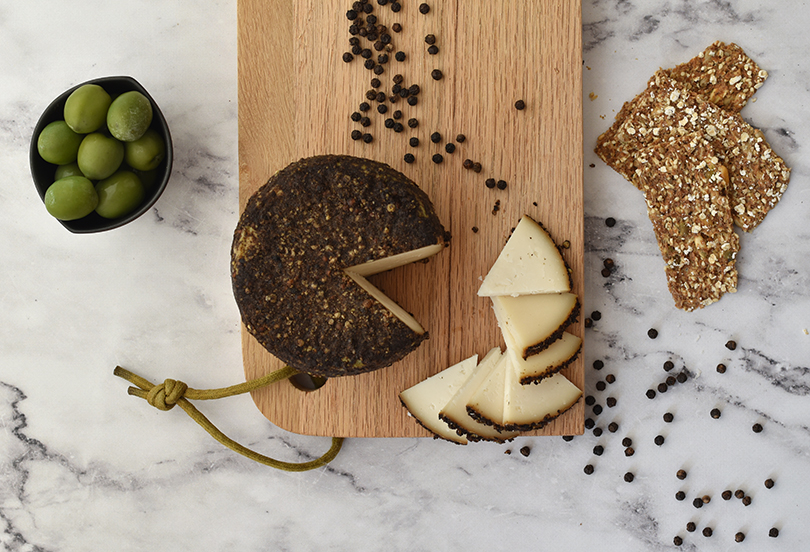
    Julia opened the door. She invited us into the small shop and told us about the family farm where they make goat cheese of unpasteurized milk from their own goats. They produce the Spanish fresh cheese requesón (ricotta style) as well as small round cheeses matured for 60 days. The cheeses mature as they are or with black pepper, paprika, thyme, rosemary or in olive oil.

    While we tasted, she explained that the farm had been in the family for many years and they had always had a few goats and produced cheese for their own consumption. Six or seven years ago they started to make cheese to sell and it has grown year by year. She is the one who converts milk to cheese every day at 7 am in the small dairy.

    Queseria Cortijo Jurtiga

    Goat cycle

    Today the family owns 1400 goats of the local breed Granadino-Murciano, renowned for its milk. They give 1½-2 liters milk pr milking (0.4-0.5 gallons) for 5-6 months a year (in total 500-600 liter per year or 130-160 gallons). In order to have milk all year round they make sure the cycles are parallel.

    Every single day two shepherds take the goats out to feed in the area among oaks and olive trees. In the late afternoon they head home for the second milking. The cheeses don’t have an organic label but they might as well…

    Queseria Cortijo Jurtiga
    Notice that the goats have eaten all they have within their reach
    Queseria Cortijo Jurtiga
    Grass turns to hay and is given to the goats. Everything is made by the family.
    Queseria Cortijo Jurtiga
    Queseria Cortijo Jurtiga

    Cheese and pepper

    Of course we bought several cheeses. The combination of the fresh acidic goat cheese and warm pepper is quite interesting.

    Goat cheese with pepper
    Goat cheese with pepper
    Goat cheese with pepper

    Do you want to see the farm dairy?

    If you are in Andalusia you can find your way to the small diary. Check out how right here.

    Goat cheese with pepper

    You can also read more about the dairy here.