Tag: French cheese

  • Beaufort from the top of the world

    Beaufort from the top of the world

    I worked as ‘cheese educator’ on an Alpine Cheese Journey – and this beaufort experience was without doubt one of the highlights.

    But before we get to the cheese, the two moments below helped set the scene:

    Scene 1:
    IN THE LIGHT OF THE MOONLIGHT

    The moon shines down from the dark morning sky onto the courtyard in front of our château. I realize that here is a group of people who have defied their body’s need for sleep and set an alarm clock. Why? Because we’re about to experience beaufort coming into the world in an alpine hut in the heights.

    Scene 2:
    THE JOB OF THE ‘CO(W)-PILOT’

    Every time the minivan enters a curve, Anna from Cheese Journeys honks the horn to warn downhill drivers. Meanwhile I keep a close eye on the pictures sent by our scout Teresa Kaufmann in WhatsApp, trying to find them outside the minivan: a wooden sign, a small group of houses, etc.

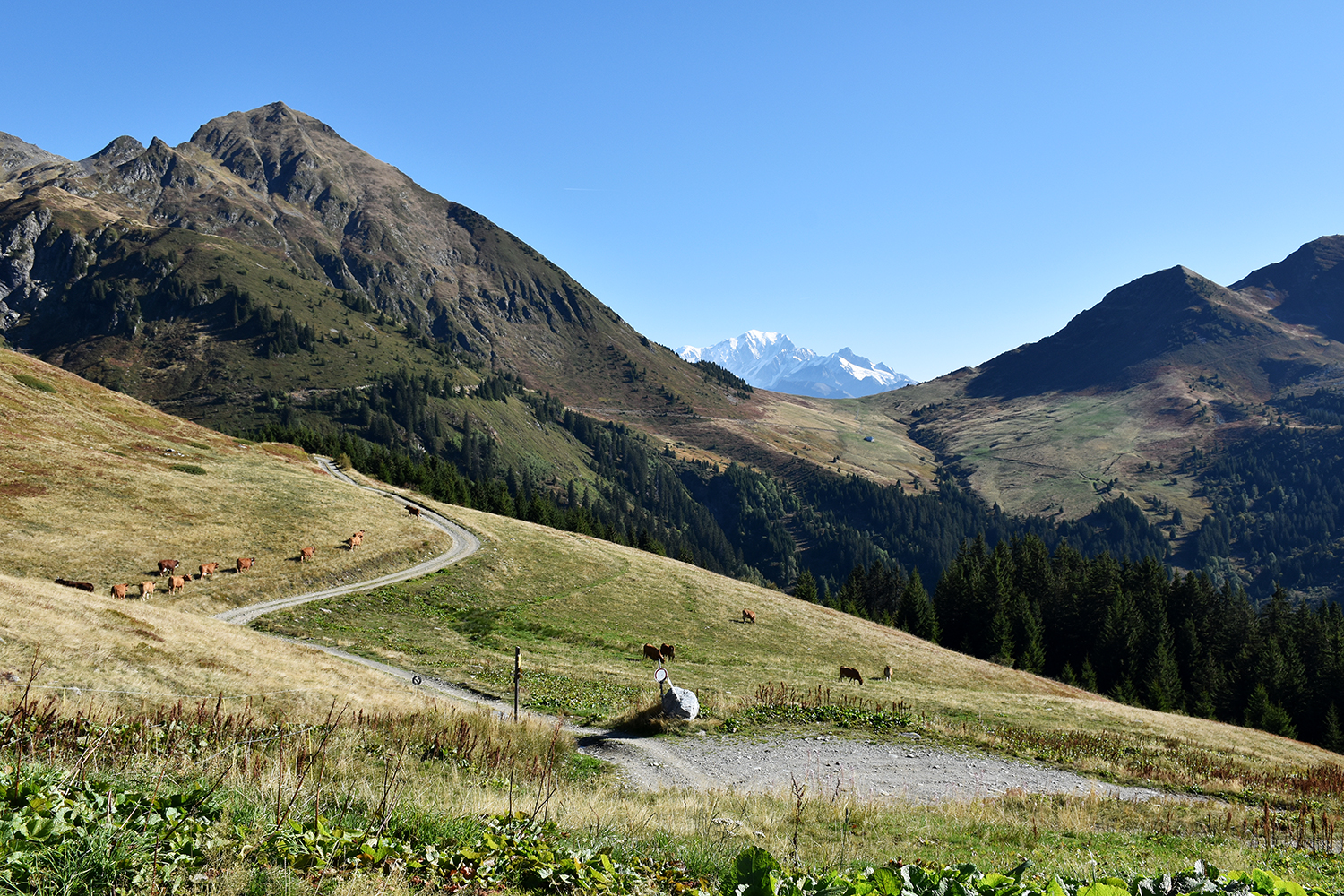
    Asphalt turns into a dirt road and the darkness is suddenly replaced by the sun. We pass the tree line – and finally we arrive at Chalet Bellachat.

    Three times Beaufort AOP

    Since 1968, beaufort has carried the AOP label, which guarantees its protection of origin. All beaufort cheeses are classified into three qualities depending on the milk and place of production:

    • If the cheese is simply called ‘beaufort’, it is made between November and May, when the cows are in the barn down in the valley. At this time of year, they mainly eat hay, which makes this type of beaufort the mildest of the three.
    • Beaufort Été means ‘summer beaufort’ and is made with milk from cows grazing outside (typically between June 1 and October 31). This type of beaufort is more yellow and fruity in flavor due to the 130 or so plant species per square meter that the cows munch through in the mountain pastures.
    • Beaufort Chalet d’Alpage – or ‘alpine chalet beaufort’ – represents the smallest part of the beaufort cheese wheels. The milk for this comes from cows grazing in the high altitudes, above 1,500 meters (around 5,000 ft). In addition, cheeses must be made twice a day with milk from the farm’s own herd using traditional methods.

    It was this last type of cheese, the Alpage variety, which was made at Alpage Bellachat.

    Alpage Bellachat

    Nathalie and Jean François greet us on this September day, just before the end of the season. Their day also starts early, as the first milking is at 4:15 am (the last at 5:15 pm). The cows recognize voices and come to the mobile milking machine themselves to be milked.

    Jean François and his brother took over this alpage (alpine hut) 18 years ago. Their parents had a small farm further down at an altitude of 1300 meters (4,260 ft), below the border of the ‘alpage’ area.

    Today, the couple has 90 cows of the breeds Tarine and Abondance, the two breeds of cows that may be used for beaufort cheese.

    Two tough mountain ladies

    The two permitted breeds are perfect for alpine areas.

    One is the tarine (or tarentaise, as it’s also known). It is a hardy caramel-colored cow. The other is the Abondance, known for its mahogany red coat with white markings. Often they have ‘lunettes’ or spectacles, as the color around the eyes is called.

    Both cows are also not allowed to produce more than 5,000 liters (1,320 gallons) of milk per year per cow. This is less than most other milking cows.

    The drought that Southern Europe has experienced in recent years is also felt at Alpage Bellachat. The lack of precipitation leads to a shortage of grass. Last year they got a dispensation to start feeding hay earlier than usual.

    The cows graze in shifts between two areas around the dairy farm. This ensures that the grass comes back. Jean François tells us that you have to maintain the ‘alpage’ by grazing, otherwise the pastures will be taken over by blueberries and other plants.

    Inside the dairy

    In the small dairy, a large open copper vat greets us. It holds 400 liters (105 gallons) of milk, which makes a 40 kg (88 lb) cheese.

    The curdled milk is cut into cheese grains and then stirred to separate more whey. The cheese grains must be quite small in order to become a hard cheese. The vat is heated with gas and the copper conducts the heat around in a balanced way that slowly brings the milk up to 55°C/131°F while stirring. This also helps to get the whey out of the cheese grains.

    The cheese maker showed us how to know when the cheese is sufficiently acidified: You can form a small ball of the curd and easily dissolve it back into cheese grains.

    When it’s time to get the curd out of the vat, the cheese maker leans over the vat with a net in his hands. Hanging there, he stems his feet against the back wall and in one swift motion, he catches all the cheese curd in his net.

    Using a hook, a string and a rail in the ceiling, the curd filled net is transported to a wooden mold, where it is pressed for 24 hours.

    The whey is used to make fresh cheese (fromage frais).

    Magic in the cheese cellar

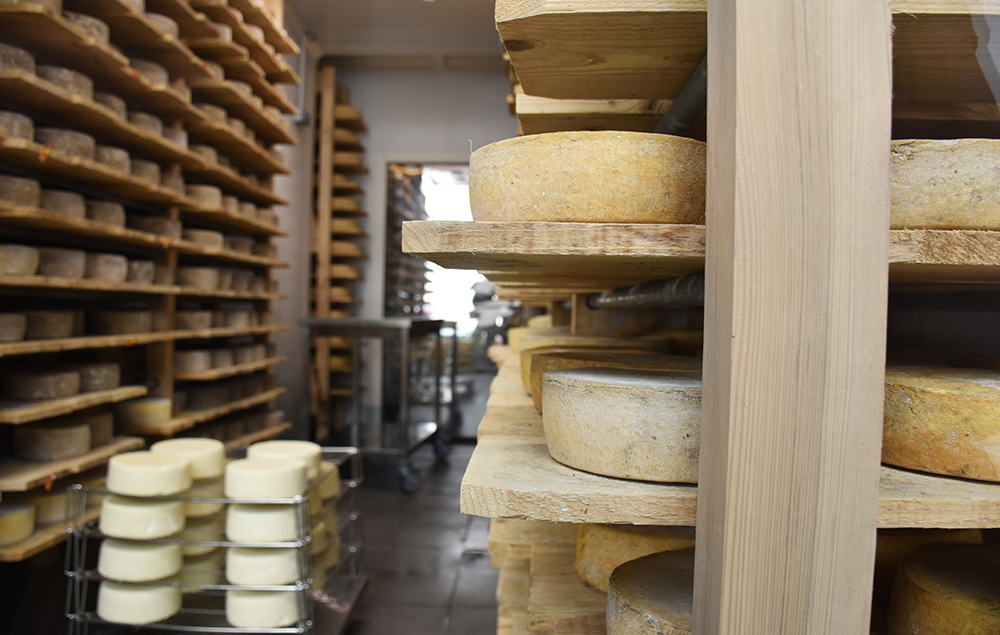
    A bit down the sloping gravel road is the cheese cellar. Here, the new cheeses are first left with salt on the surface for 24 hours to form a rind. They they spend another 24 hours in a concentrated brine. The cheeses then ripen for about 10 days and are regularly rubbed on the surface. You always start with the oldest cheeses, as this way the good bacteria are spread to the youngest cheeses.

    The beauforts are then transported down the valley to an affineur, who further ripens the cheeses under more controlled conditions. To be a genuine beaufort cheese, it must be aged for a minimum of five months in the Beaufort area.

    The connection between skiing and cheese

    Many cheesemakers in the area double job as ski instructors in the winter while the cows are stabled down in the valley. So does Jean François, who is a cross-country ski instructor in the winter time.

    Lunch with a view of Mont Blanc

    After the visit to the dairy and cheese cellar, we quickly set up a long table with tablecloths and served our lunch. Jean François brought some beaufort cheeses with different ages to the table.

    Beaufort. A view of snow covered Mont Blanc. The soft sound of cowbells in the distance.

    It doesn’t get any better than this!

  • The story behind comté

    The story behind comté

    Did you know that comté cheese is the French’s favourite PDO cheese (PDO = protected designation of origin)? And that it was the first French cheese to be protected by origin in 1958?

    This classic cheese was of course also on our agenda when I visited the French Alps and the Jura Mountains with Cheese Journeys. We visited both a dairy and an affineur who ripens the cheese. In this blog post I will take you with me back to the Jura.

    A historical structure

    Around 1.7 million wheels of comté cheese are produced every year, each weighing around 40 kg / 88 lbs. Each cheese requires 450 litres / 119 US gallons of milk. Since one cow gives about 20 litres / 5.3 gallons of milk a day, 23 cows are needed to make one cheese. In addition, the PDO requires each cow to have one hectare of pasture. This requires large areas of land, which was also the case 1,000 years ago up in the mountains. But with relatively few cows per farmer, it was more practical to join forces when it came to cheese making, hence the birth of cheese cooperatives (‘les frutières’). Today, cooperatives are still responsible for making the cheese, while the maturing process is taken care of by the specialists, ‘les affineurs’.

    Let’s start at the beginning, with the cows.

    The cows

    150,000 cows give milk for comté. 95% are Montbeliarde cows, the remaining 5% are French Simmental. The cows eat only grass and hay. In winter (December to April) the menu is locally produced hay, while the cows graze through fresh grass outdoors the rest of the year.

    Comté is a raw milk cheese, which also means that the subtle notes in the milk from grass and hay are more apparent. Cheeses made from winter milk have a lighter yellow color than summer cheeses, where the natural coloring of the grass gives a darker yellow hue.

    Drought affects the seasons

    As elsewhere in southern Europe, 2022 has been marked by drought. This meant, among other things, that hay feeding began earlier in the fall than usual. And that cows began to eat fresh grass earlier, which meant that summer milk was already available halfway through April.

    At the dairy

    Today, there are about 140 cheese cooperatives left. In French it’s called a ‘fruitière’. The term comes from the French word ‘fructerie’ and refers to the fertility of pooling milk to produce large quantities of cheese. As well as being a practical and necessary gathering place for milk in the old days, ‘le fruitière’ was also a social gathering place for farmers.

    This is why it is still an AOP requirement today that milk comes from several farms. The milk cannot be transported more than 25 km / 15 miles to preserve its quality, and the cheese must be made within 24 hours of milking.

    Each dairy produces between 7 and 120 cheeses a day. After 10 days, cheeses are taken to an affineur, who ripens the cheese further. The dairy can easily work with several different affineurs, and in this way the same dairy’s cheeses can end up having many different personalities.

    L’affineur

    Today there are 16 affineurs or maturing cellars, where the potential behind each comté wheel is revealed. A comté must mature for a minimum of four months, the average is 18, and some can mature for as long as 36 months.

    The role of the affineur is to bridge the gap between the producer and the customer. With knowledge of the cows, the area and the dairy, each wheel of cheese is brought to perfection for the customer who buys it. After all, there is a difference between the cheese being sold at a local French cheese shop and the cheese ending up on the counter in California.

    In the Jura mountains, the affineurs like to use maturing cellars which naturally create good conditions for the cheeses, such as an old railway tunnel or an abandoned military fort.

    I visited Marcel Petite at Fort Saint Antoine.

    Inside the military fort

    In the heart of the Jura Mountains (1,100 m / 3.600 feet above sea level) and close to the dairies, we find Fort Saint Antoine, built in 1879-1882. It was only in use for five years before the 420 soldiers left.

    Marcel Petite started as a cheese maker in 1932, and in 1966 he came across the military fort. He saw that the thick stone walls and an insulating layer of earth on top would provide the perfect conditions for a slower ripening of the cheeses than was used at the time.

    Under the fort is a water reservoir filled with rainwater and melted snow, providing the soldiers with their own water supply. This keeps the humidity in the fort high. A tunnel to the nearby forest provides natural ventilation. All of this gives optimal conditions for the unique and natural bacteria that are right here and that characterize the cheeses which mature in the fort today.

    At the centre of the fort is an octagonal ‘cathedral’. Here lie as many as 100,000 wheels of cheese in the age between 2 and 36 months. An impressive sight!

    Slowed down

    Back in the days, comté cheeses were aged at 16-18°C / 60-64°F, which allowed them to ripen quickly and reach the market faster. However, this method of ageing also meant that the delicate nuances and subtle hints of sweetness of the milk were not expressed at all. And maybe most remarkably, the cheese had holes (almost like an Emmental). Just look at the old advertisement below.

    The microclimate of Fort Saint Antoine ripened the cheeses more slowly with the lower temperature (8-9°C / 46-48°F) and higher humidity (95%). This gave the cheese a completely different flavor profile. This slow maturing changed comté cheese forever, as the other affineurs soon began to do the same.

    Knocks on every cheese

    In the maturing process, an important step for the cheese master is to ‘ring the wheel’ or hit it several times with a small hammer to make an overall scan of the cheese inside and to detect a possible large crack or hole.

    Age matters the least

    Then a sample is taken out with a so-called ‘cheese iron’. The interior of the cheese is assessed for appearance, taste, texture and smell. Age is also important but not decisive and always comes after the organoleptic assessment. Only when the cheese has developed the desired personality, it will be sent to the market.

    In a Marcel Petite Comté catalogue, the age of the cheeses were not mentioned at all. Instead, they were described only on the basis of their other characteristics.

    Ageing develops the flavor

    As with other aged cheeses, each wheel of cheese tells us a story about the past: About the pastures where the cows grazed, about the season, about the cheese-maker’s skills and about the cheese cellar where the cheese has been aged.

    In fact, 83 flavor markers have been identified for comté and they can be divided into six groups: Lactic, fruity, toasted, vegetable, animal and spicy. Some cheeses may have all the flavours, but most have a few which dominate.

    The flavor wheel helps to find the right words to describe the flavor. Use it the next time you have a comté in front of you.

    At the dairy, they sold their own cheeses matured by three different affineurs. You can then choose the comté you like best for the situation!

  • Paris. Love. Cheese.

    Paris. Love. Cheese.

    Fromage à trois. Paris. Love. Cheese.

    This is the title of a ‘feel good’ book which takes place in the center of Paris. And where love and cheese play equally big parts of the book. Just the right mix for a romantic cheese lover.

    It all began with comté…

    Australian Ella is heartbroken. She decides to get away – and why not go to Paris where she had her first bit of a fruity and nutty comté and so many other happy memories… Suddenly and with a one-way ticket in her hand, she is in Paris. Searching for a job, an apartment and happiness… and wouldn’t the best way be to start with some cheese? She meets Paris through the cosy cafés (and their cheese plates) and of course she finds her favorit cheese monger. We follow Ella through her first year – and in her company we go through a lot of cheeses 🙂

    I’m telling you: If you’re in to cheese, Paris and romance – you’ll love this book!

    Fromage a trois

    Happy Valentine’s Day!

    Have you read about urban dairies in Paris?

  • Urban dairies in Paris

    Urban dairies in Paris

    GUIDE TO CHEESE IN PARIS

    Normally, dairies are quite close to the source of milk, and this is most often in the countryside. I have just been to France (Normandy and Pays de la Loire) and therefore I do know how many miles or kilometers you sometimes have to drive to reach the dairies…

    But in recent years, small dairies are popping up in Paris. In the middle of the big city and far away from the milk animals. These urban dairies are an attraction per se and consumers as well as local restaurants happily buy their products.

    Use the addresses below and go see for yourself next time in Paris.

    Stop #1: Laiterie de Paris

    Laiterie de Paris

    In the neighborhood of La Goutte d’Or (close to Montmartre in the 18th arrondissement) you find the first Parisian dairy. Run by the young Frenchman Pierre Coulon. He used to work in the legendary cheese store Maison Androut as well as being a cheese maker on his own farm with goats and sheep in West France.

    Now he is back in Paris and since the end of 2017 he has made yoghurt, butter and cheese (mainly fresh cheese) of organic cow, goat and sheep milk from Bretagne and the Seine Maritime region. Besides his own cheeses, the shop carries an assortment of other delicous cheeses as well as beer, wine, jam and honey to accompany the cheeses.

    Laiterie de Paris
    Laiterie de Paris
    Laiterie de Paris
    Laiterie de Paris

    Visit Laiterie de Paris:

    74 Rue des Poissonniers
    75018 Paris 
    Facebook
    Instagram


    Stop #2: Laiterie La Chapelle

    Laiterie la Chapelle

    Not so far away you find another small dairy with a slightly different philosophy. Paul Zindy recieves milk four times a week from farms just outside Paris (and therefore his cheeses are made of cow milk). His focus is local which you can also see in the name of the cheeses. For instance Dormoy which is the name of a nearby metro station. His raw milk cheeses mature on wooden planks and can be seen from the street as well as from the inside of the shop.

    Laiterie la Chapelle
    Laiterie la Chapelle
    Laiterie la Chapelle

    Workshop: Make your own tommette

    Laiterie La Chapelle now invites you to join them in the dairy, put on your apron and learn to make your own cheese. In small groups (3-5 persons) you will make a tommette (small hard cheese). After three months of maturation, you can pick up your cheese and taste the result. Read more and book here (in French).

    Laiterie la Chapelle

    Visit Laiterie la Chapelle

    72 Rue Philippe de Girard
    75018 Paris 
    Website
    Instagram
    Facebook


    Stop #3: Nanina – raw milk bufala mozzarella

    When I researched for this blog post, I came across this urban dairy in the 11th arrondissement. They make mozzarella from raw bufala milk from Auvergne. Nanina is the name, and it is on my to-do list for the next trip to Paris.

    Visit Nanina

    24 Rue Basfroi
    75011 Paris
    Facebook

    Stop #4: Ottanta – organic mozzarella, burrata and more

    Another name on my bucket list for Paris is Ottanta where they make organic fresh cheese such as mozzarella, burrata, ricotta as well as stracciatella (and fresh pasta). They also make mozzarella and burrata workshops (organized by Yeswegreen).

    Visit Ottanta

    19, rue du Cardinal Lemoine
    75005 Paris
    Website
    Facebook