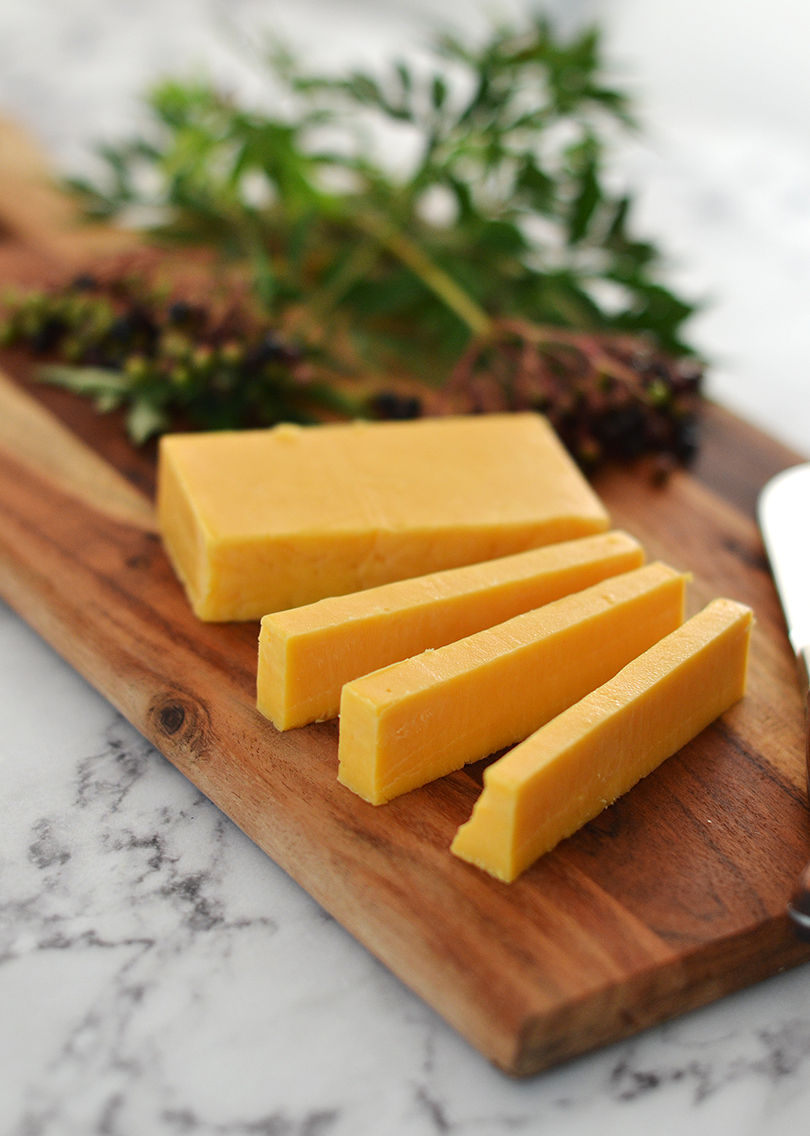
With the arrival of baby goats, spring is back and the new season for goat cheese starts. Typically, fresh goat cheeses are more creamy during spring.
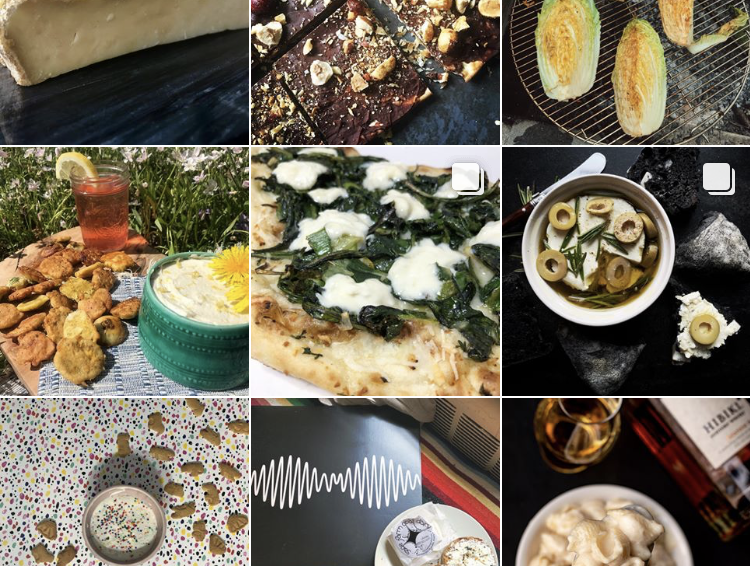
A group of cheese influencers decided to pay tribute to goat cheese by posting simultaneously on instagram on April 24, 9 AM CT.
Instagram collab
The idea was simple: Post a pairing or a recipe. Of course the results are as different as the persons behind – take a look at the photos below. I invite you to visit the instagram profiles and read about the goat cheese post and see more cheese shots.
For the fifth time and all over the world it is International Raw Milk Cheese Appreciation Day. The organisation Oldways Cheese Coalition stands behind.
What is raw milk?
When you make cheese out of raw milk, the milk is not heat treated (for instance pasteurized or thermised). In stead the temperature is kept at the level of the temperature of the cow which is around 37°C / 99°F.
Milk is from nature’s side filled with natural bacteria and microorganisms. Some of these are flavor-carrying bacteria and will add depth and complexity to the taste of the raw milk cheese.
Some bacteria can under wrong circumstances develop harmful bacteria and therefore we sometimes find restrictions on raw milk cheeses. Danish dairies for instance need dispensations from the authorities, and raw milk cheeses can only be sold in the US if they are matured more than 60 days.
Well known raw milk cheeses
You might not think about it, but many European cheeses are made of raw milk. Parmesan (parmigiano reggiano) and grana padano, comté and roquefort must according to their DOP / AOP be made of raw milk. Other cheeses can be found in raw milk or pasteurized milk versions such as manchego DOP and taleggio DOP. And yet others such as emmental, gouda, and cheddar can be found with or without DOP label and with both milk treatments.
Tingling on the tongue
Sometimes you feel a small tingling on the tongue when you eat raw milk cheeses, especially some of the more matured versions.
This is due to histamine which comes out when certain aminoacids (protein) is broken down during maturation. As the milk hasn’t been heat treated it contains more milk acid bacterias which produces this reaction. Histamine in small doses is no problem, it just gives you this delightful mouth feeling.
Raw milk cheese and tradition
Apart from taste, some people also connect raw milk cheese with culture and tradition as this was the original way to produce cheese before we began to pasteurize milk in the 19th century. In other words, raw milk cheeses is part of our gastronomic heritage.
Enjoy a raw milk cheese today on this fifth International Raw Milk Cheese Appreciation Day!
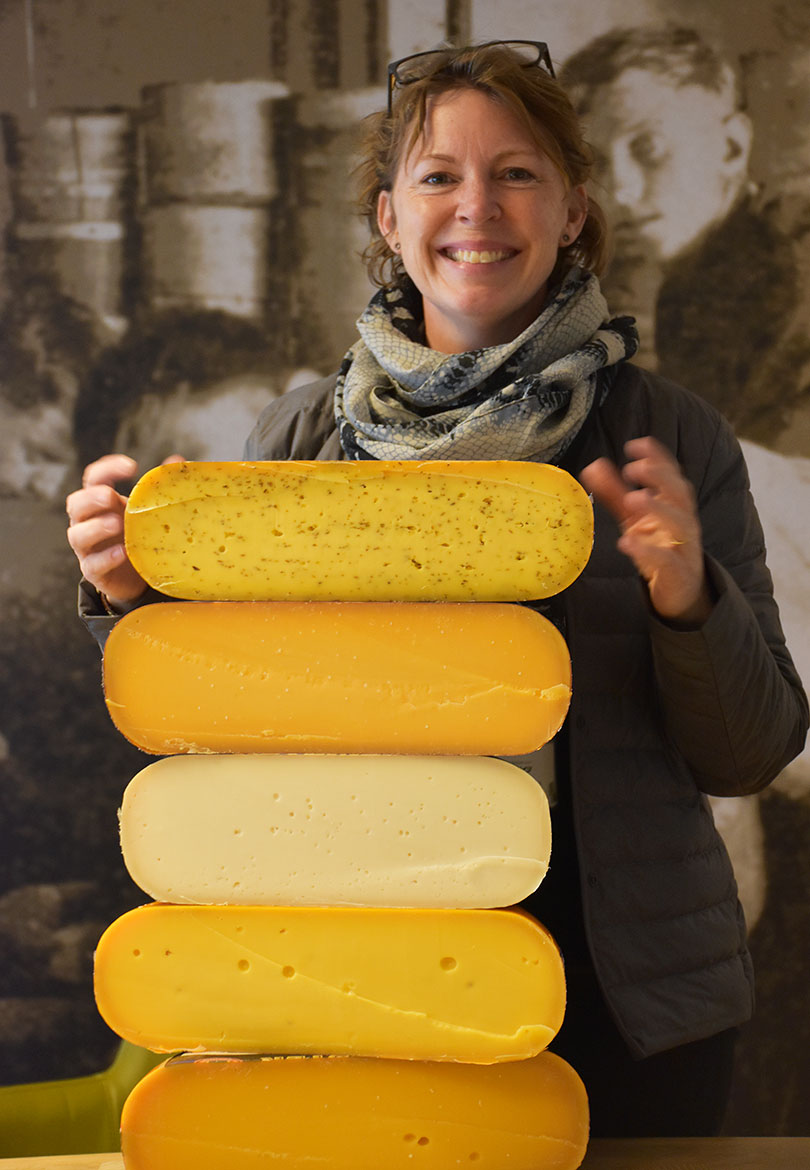
I have taken one week out of my life and dedicated it to Dutch cheese. Together with a group of American curd nerds, I am on my first Cheese Journey.
When I’m back home I will serve the full experience garnished with information and insights. For now, I will give you some snaps from our first days. Life is gouda!
Or: There is always a cheese moment around the corner.
My husband and I were on a short getaway in Andalusia (south of Spain). We were driving around in the mountains when he suddenly stopped the car and pointed at a sign. It was a little rusty but the words were clear: Four kilometers (2.5 miles) away was the farm dairy Cortijo Júrtiga. Of course we had to check it out and turned onto a dirt road.
Cool mountain air and silence met us when we stopped. A dog was barking somewhere and a motor was running. We saw several buildings and found the door to the cheese shop.
Welcome
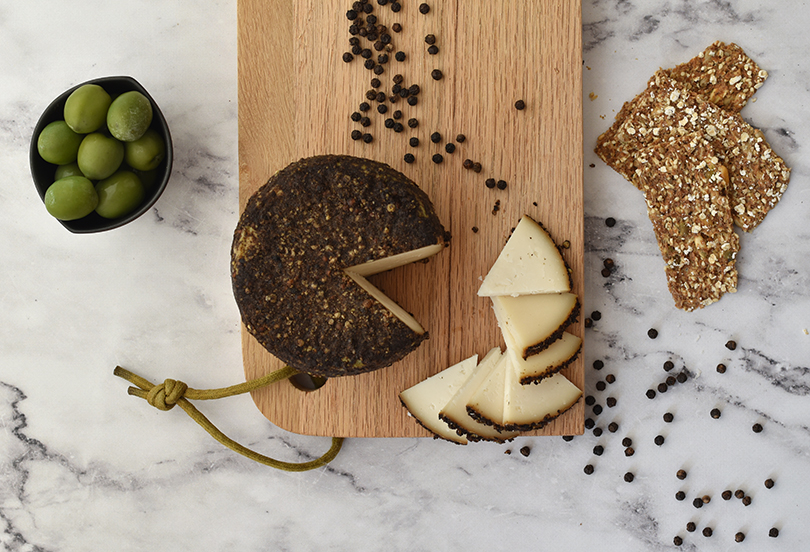
Julia opened the door. She invited us into the small shop and told us about the family farm where they make goat cheese of unpasteurized milk from their own goats. They produce the Spanish fresh cheese requesón (ricotta style) as well as small round cheeses matured for 60 days. The cheeses mature as they are or with black pepper, paprika, thyme, rosemary or in olive oil.
While we tasted, she explained that the farm had been in the family for many years and they had always had a few goats and produced cheese for their own consumption. Six or seven years ago they started to make cheese to sell and it has grown year by year. She is the one who converts milk to cheese every day at 7 am in the small dairy.
Goat cycle
Today the family owns 1400 goats of the local breed Granadino-Murciano, renowned for its milk. They give 1½-2 liters milk pr milking (0.4-0.5 gallons) for 5-6 months a year (in total 500-600 liter per year or 130-160 gallons). In order to have milk all year round they make sure the cycles are parallel.
Every single day two shepherds take the goats out to feed in the area among oaks and olive trees. In the late afternoon they head home for the second milking. The cheeses don’t have an organic label but they might as well…
Notice that the goats have eaten all they have within their reachGrass turns to hay and is given to the goats. Everything is made by the family.
Cheese and
pepper
Of course we bought several cheeses. The combination of the fresh acidic goat cheese and warm pepper is quite interesting.
Do you want to see the farm dairy?
If you are in Andalusia you can find your way to the small diary. Check out how right here.
In Denmark, we have a cheese which is eaten more than any other cheese. Many people even eat it on bread for breakfast – despite its particular odeur of smelly feet. The name of this type is Danbo. Export of this cheese is quite small – I guess you have to be Danish to really understand and appreciate it 😊
Since October 2017, it has carried the PGI label (Protected Geographical Indication). This is the third Danish PGI cheese (the others being danablu (blue mould) and esrom (a red smear-ripened cheese).
‘Beskyttet Geografisk Betegnelse’ is the Danish translation of ‘Protected Geographical Indication’.
Particularly Danish
This very Danish cheese was born with inspiration from abroad (as it is the case of most Danish cheeses).
In 1896, a young and talented cheesemaker Rasmus Nielsen received a travel scholarship from the state to study cheesemaking abroad. He learned a bit of German, packed the suitcase and went to East Prussia, close to the Russian border. This area of vast plains with grassing cows was famous for its high quality cheeses. Like a dry sponge in water, he absorbed inspiration from the small dairies in the area. He went on to Holland where he picked up more inspiration and knowledge from the local cheesemakers.
Back in Denmark after travelling around for half a year he gathered all impressions into a new cheese – out of the cheese vat came a square cheese washed with a mix of bacterial and yeast cultures.
A classical ‘ostemad’: A slice of danbo on rye bread or as shown here on stone age bread. Photo: Ditte Ingemann, from my cheese book ‘OST på Bordet’ (in Danish)
The Danish Way
Cheese makers talk about ‘the Danish method’ and refer to the smear-ripening of danbo and other Danish cheeses. The selected bacterias and yeast cultures help the cheese to ripen and give taste and smell. In fact, this type of cheese has a quite strong ‘odeur’ (you know it when you open the fridge and smell it immediately 🙂 )
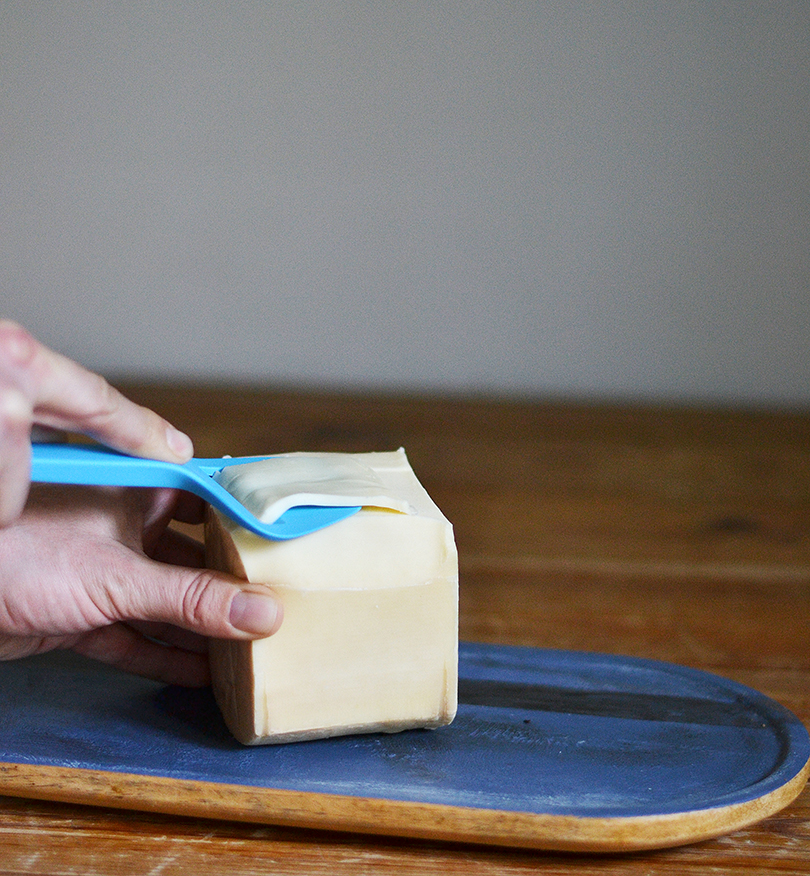
The cheese has a high water content which gives a soft texture and makes it easy to slice.
Not so typical – but yet a good pairing: Rye bread with a slice of danbo topped with avocado and rocket salad
What does the PGI mean?
With the PGI label (Protected Geographical Indication), danbo is in the same group as for instance tomme de Savoie IGP and emmental de Savoie IGP.
For danbo it means that it must be produced in Denmark. The taste should be ‘mild, with a bit of acidity, aromatic and with the typical taste from the smear-ripening’. You are allowed to add caraway as long as the cheese gets the taste and smell of the aromatic seeds.
Danbo is found with various maturations. The taste goes from mild to very strong!
Coming back from our ski vacation last week we had a stopover in Oslo, Norway. We paid a visit to Mathallen, a gastronomic arena with a fine collection of delicatessen shops, places to eat and a vast program of cooking schools and other events.
Of course, cheese was represented. Galopin is a cheese shop specializing in French cheeses and their shop was full of interesting artisan (fermier) cheeses.
Just a bit of blue
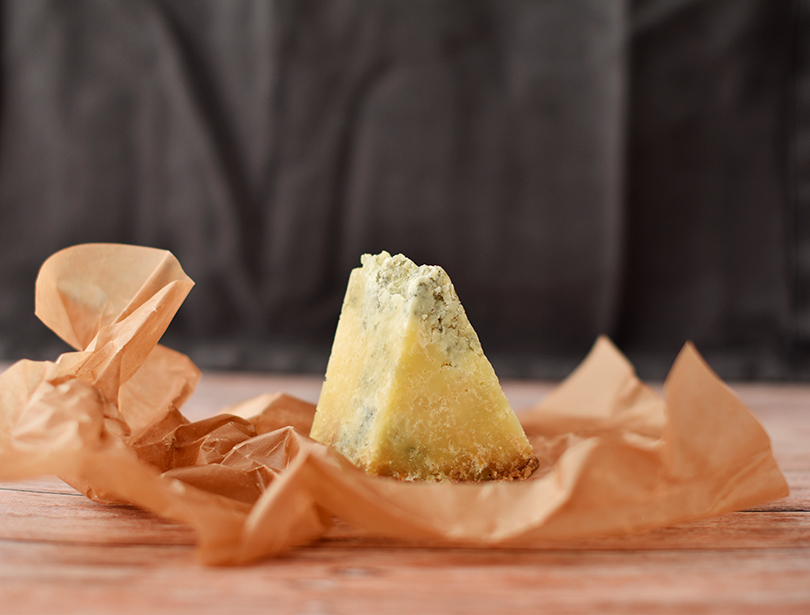
Among the many fantastic and colourful cheeses, especially one called out. It looked a bit shy with its random small bits of blue veins. But when we tasted it, we were blown away. The name is Bleu de Termignon!
A raw blue mould cheese from the Eastern part of the French Alps, close to the Italian border. Only few cheese makers produce it, and only between June and September where the cows are grazing high up in the Alps (more than 6500 ft of altitude) and thereby the cheese is made with ‘alpage milk’.
Taste explosion
The taste had a bit of acidity and bitterness and lots of animality. A hint of sharpness and an large aftertaste. It is not a cheese for beginners 🙂 It produced a small prickle on the tongue which is typical for raw milk cheeses.
The curds
The texture was crumbly and creamy at the same time. If you take a close look, you can almost see small lumps of curds – and the process is also different from many other cheeses. Some of the fresh curds are mixed with older curds, and some are left in brine one or two days until they will be mixed with new fresh curds. The curd blocks are being minced which aerates the curds before they are mixed, salted and put into forms.
In fact, it has some ressemblance with the cheddaring process and maybe that’s why I also thought of a very mature cheddar when I first tasted the cheese.
Maybe blue – maybe not
The blue mould in Bleu de Termignon also makes it different from other blue mould cheeses. Normally, you add blue mould culture to the fluid milk when you produce a blue cheese. Maybe the mould is made from the natural mould in the area (for instance from the caves of roquefort). The cheese is pierced with long needles in order for air to enter and blue mould can grow.
In the case of Bleu de Termignons you do nothing. No blue mould culture. No needles. The mould is in the chalet and in the wooden tools. When the curds are minced, the mould finds it. Or it doesn’t. Sometimes the cheeses have no blue.
I only know of cabrales which matures in caves in Asturias (Spain) where they don’t add mould nor pierce the cheese.
Colourful rind
Nature has wrapped this cheese in a beautiful, quite thick rind dotted with all colours from the brown palette. The small red dots, ‘le fleur rouge’ is also found on the rocks in the area. This cheese is really a piece of nature.
Visit an alpine chalet
The French affineur (one who matures cheese) Mons has made a really cool film showing the cheese life of one of the six producers. If you have 12 minutes, grab a coffee and take a break while you enjoy the scenery and see how nature and cheese making is closely connected. You will see how the milk from 18 cows gives three cheeses. Feel the weight of the buckets filled with milk when they are carried from the small barn to the dairy in the other chalet. See how Catherine’s arm muscles are growing when she minces the curds.
The cheese monger from Oslo smells the Bleu de Termignon. He senses the story of the remote Alpin area, the cold, damp cheese cellar in the chalets and the wild herbs being eaten by the cows…
Needless to say, if you ever come across Bleu de Termignon, please taste it! 🙂
To be honest, I don’t personally celebrate Valentine’s Day. Nor do I celebrate Mother’s Day or Father’s Day. Not because I am an uncaring cold fish but because I believe we should remember to celebrate love every single day of the year. And that every day should be good for mothers and fathers.
Say it with… cheese
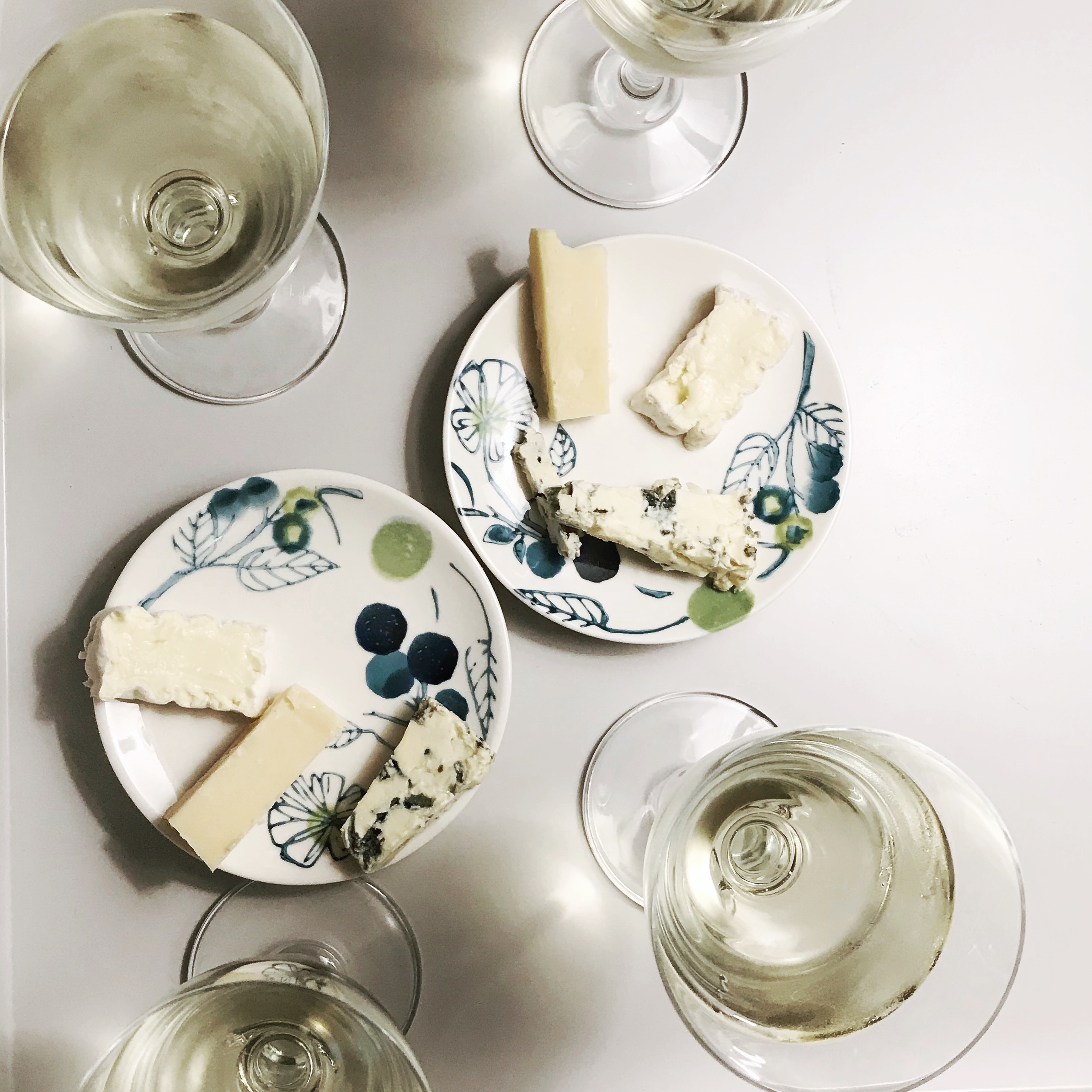
Valentine’s Day or not, one way to express love is to give an unexpected, personally curated and well considered gift. It can be a small plate with great cheeses served at the right moment.
Express your love through cheese
Find two small plates or saucers. Place your love’s favourite cheeses on them. Or toast a bread, top with cheese and maybe a bit of compote. And most important: Spend the break together, enjoy the cheese moment. The small moments matter!
Here the cheeses are accompanied by two types of white wine; a dry and a slightly sweet
The more you dig into the amazing cheese universe, the more nerdy details and complexities you meet.
Take for instance the shelves on which the cheeses mature. Have you ever thought about which material the shelf is made of? And why this is worth giving a thought?
Shelves made of wood
Originally, cheeses matured on wooden shelves as wood was all around. In some cases today, the wooden shelf has actually become part of the AOP-designation. Take for instance mont d’or AOP: This seasonal cheese must mature on spruce boards (as well as having a spruce belt around and is finally placed in a spruce box). The tannins contribute to the taste and character of the cheese (which actually is no different from wine maturing in oak barrels).
The wooden boards are washed between each production but you cannot sterilize wood as it is a porous material. Remains of cheese culture from former cheeses will always be present and passed on to the next cheese residing on the shelf. And thus the wooden shelf plays a roll in the maturing process.
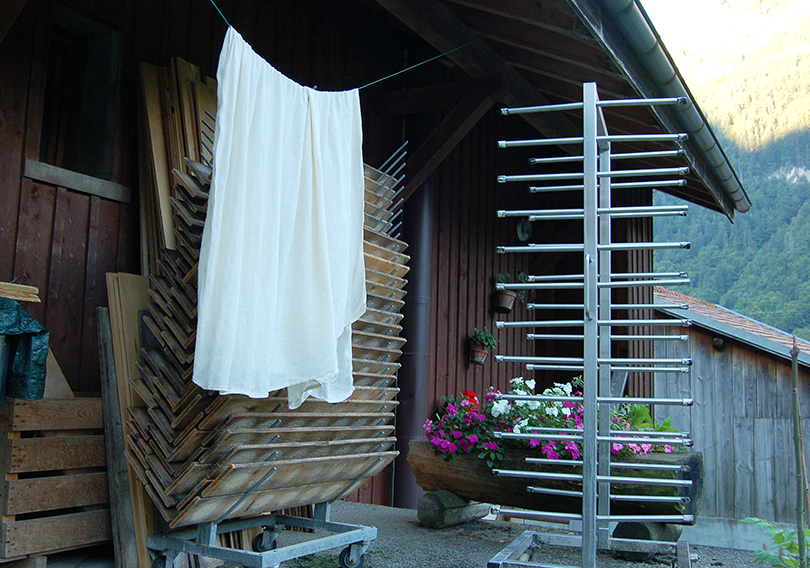
These wooden boards are drying outside a farm dairy in the French Alps.
Once I met the tomme cheeses below in an Alpine dairy in France. When the cheese is ‘newly born’ (as to the left) they are placed in the cellar together with the elderly and grey cheeses (to the right). This is how the mould is spreading to the newcomers which aren’t sprayed or washed to get the mould. It is already in the room!
Symbiosis of moisture and wood
I need to mention another detail. Wood absorbs the excess moisture in the room and in the cheese – but it can also pass on moisture to the cheese in case it gets too dry. This moisture exchange does play a role in defining the texture and taste of the cheese. When a cheese matures, moisture dissappears – in a controlled way. When the cheese lies on wood, the wood absorbs the excess moisture and helps the cheese to form a rind. If a moist cheese is soaking in liquid it will instead create the perfect conditions for unwanted microorganisms. On the other hand, if the room is too dry, the cheese will absorb the moist from the wood and thereby prevent it from drying out. As simple as that!
Affinage of Danish cheeses
Some years ago, it was decided due to hygiene factors to ban the use of wooden shelves in the maturing of parmigiano reggiano. But soon the cheese masters discovered that the cheeses didn’t develop the same taste and soul as before. The result? Wooden boards are back.
Not all types of cheese mature on wood. Some mould cheeses or washed cheeses lie on shelves of plastic, stainless steel or on a layer of paper or cloth. It all depends on what the cheese needs in order to bloom as much as possible.
After I made the cacio e pepe pasta dish with pecorino sardo I will share with you some background information about this cheese.
The name pecorino comes from the Italian word ‘pecora’ which means sheep. Thus, pecorino is a group name for (hard) sheep milk cheeses from Italy.
But pecorino isn’t just pecorino. As in every other family, the members come from different areas and have very different characters. Today, eight pecorino cheeses carry the DOP designation.
But for now, let’s focus on pecorino sardo DOP.
Pecorino sardo from Sardinia
Pecorino sardo is one of the most known pecorino cheeses and comes from Sardinia. As with other origin protected cheeses it is all about a cultural and geographic heritage which is now described in details in the DOP designation.
On Sardinia they have a long shepherd tradition. Three million sheep are walking around on the island, grazing wild plants which influences the quality and taste of the milk. The milk used for pecorino sardo must be full fat sheep milk from a sheep which has grazed on Sardinia. The milk may be pasteurized or thermized.
Two maturations
Pecorino sardo comes with two maturations:
Dolce is the mild type, matured for 20-60 days. The cheese has a green label and is about two kg / 4.4 lb. The cheese curd is cut to the size of nuts.
Maturo on the other hand matures at least two months but most often between four to six months. It wears a blue label, weights around 3 kg / 6.6 lb and the cheese curd is cut to the size of rice grains. (By having smaller cheese curds you have a larger total surface which the whey can leave more easily. Thereby, the texture gets more solid – and more suited for a longer maturation).
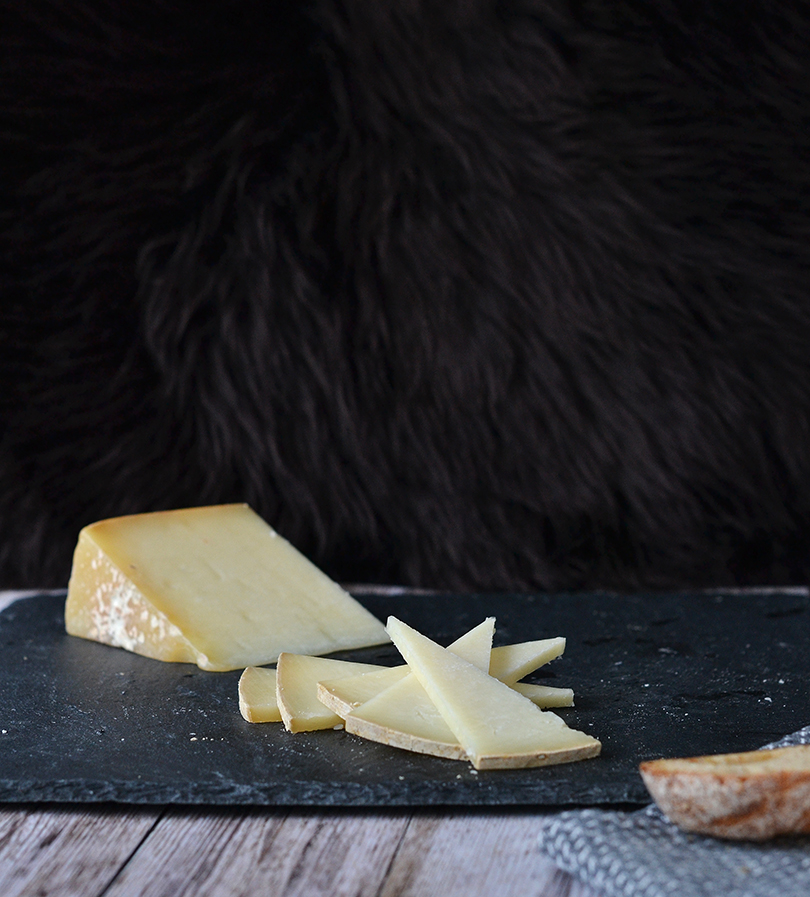
Sheep milk contains more lactose compared to cow milk and this gives a slightly more sweet taste. The two types of pecorino sardo are quite different. The dolce is delicate, flexible/soft and has a bit of acidity whereas the maturo on the other hand is more crumbly and has a pleasant sharpness.
On Sardinia, the locals use the mild cheese for cooking and the matured for tapas. They suggest you serve the cheeses with white wine (for instance an oak matured chardonnay) or a red wine with acidity (such as a beaujolais).
Experience pecorino sardo on Sardinia
There are around 20 producers on Sardinia. They are happy to welcome visitors who have the interest and desire to know more about pecorino. On the website of the consortium you can see how to get there (and do take a look at the other attractions now you are there). So far, the website is in Italian – but with a bit of will power and Google Translate – you can make it! 🙂
Have you ever wondered why some cheddar cheeses are white and others are red? Well, I have 🙂 and of course there is an interesting story behind which takes us 400 years back in time…
Natural eye catcher
But first things first. What is the colour actually? It is the natural colouring agent annatto which is made out of seeds from a small tree originating from South and Central America. The name of the tree is bixa orellana and it has big beautiful red flowers. You extract the powerful colour from the seeds. Through out the years, man has used the colour to dive clothes, butter and cheese…
Cheating the cheese better
Around the 16th century in Britain, people agreed upon that a quality cheese was dark yellow or even light orange. Maybe it began from the fact that the best cheese makers used milk from cows grassing outside during summer, a milk which naturally was full of Beta Carotene. A colour which was intensified as the milk was turning into cheese. It could also be that the best cheese makers at that time used the full fat morning milk which was mixed with the cream from the evening milk the day before.
Regardless of the reason, a cheese with a dark colour could be sold at a higher price….
The habit of using a colouring agent in the cheese production spread, and today we see it in cheddar (some of them), double glouchester and red leicester (the two last cheeses are British traditional regional cheeses).
This was a bit of cheese knowledge for you – had you already wondered about the colour or not…